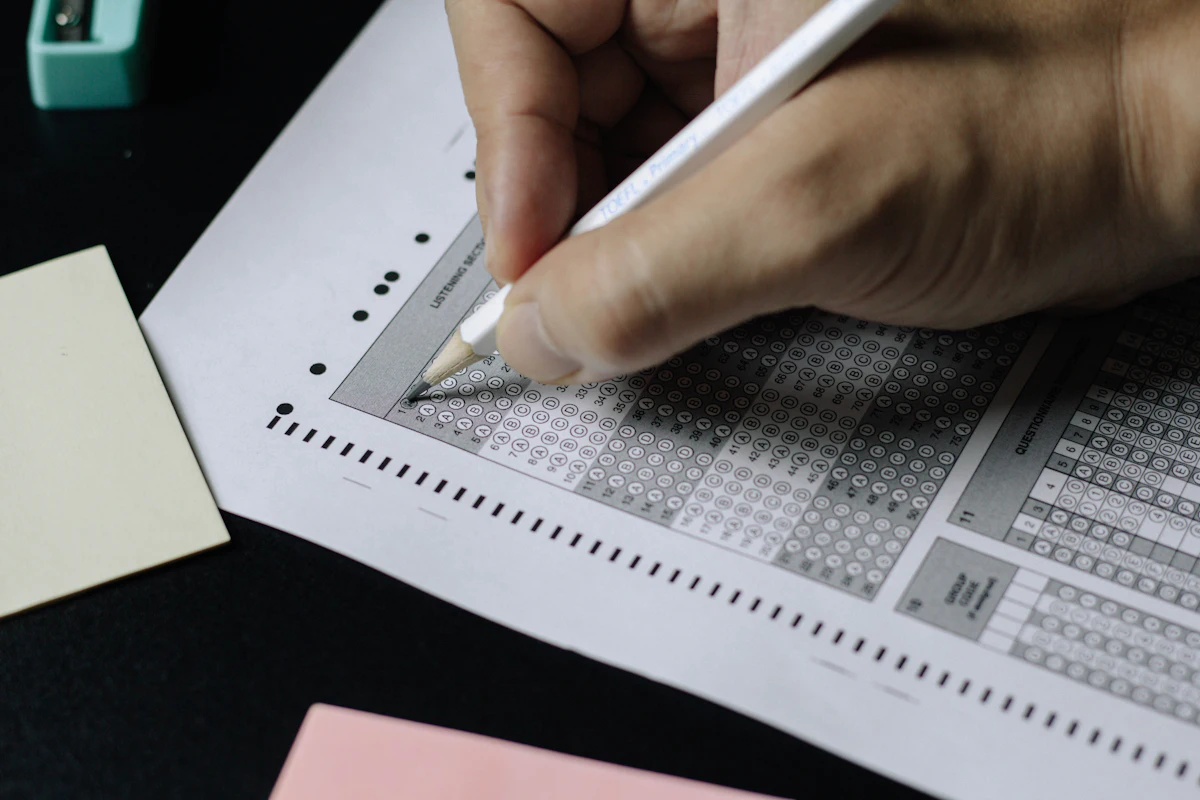
You spend months preparing for IELTS, yet many candidates never learn how the exam day itself works — and that uncertainty fuels extra anxiety. In reality, test day follows a very predictable routine, and once you know it, almost nothing can catch you off guard. Here is the whole process, step by step — from the final week to receiving your results.
The week before the exam
The last week is for organising what you already know and shifting into "exam mode" — not for cramming.
- Fix your sleep schedule. The exam usually starts in the morning, so spend the final week waking up at your test-day time — your brain needs to get used to working at full capacity early.
- Do one full mock test. Four or five days out, sit one complete test under real conditions — it refreshes your sense of timing and reveals last weak spots; see how to take an IELTS mock test effectively. In the final day or two, ease off heavy practice.
- Don't cram new vocabulary. New words in the last few days don't help — the feeling of "how much I still don't know" only drains confidence. Lightly review what you've already learned.
- Plan your route. Check where the test centre is and how long the trip takes.
What to bring with you
One hard rule: you must bring the exact same passport (or ID) you used when registering. If the document number doesn't match your registration, you won't be admitted — that isn't up to centre staff; it's an international rule. Check the expiry date in advance too.
The rest of the list is very short:
- Water — allowed only in a transparent bottle with the label removed.
- Phones, watches, smart devices, notes — none may enter the exam room. Many centres provide pencils and erasers on the spot.
- The exact list can vary slightly, so confirm it with your test centre (IDP or British Council) beforehand.
Tip: The evening before, put your passport and confirmation letter somewhere visible. Hunting for documents in a morning rush is the most unnecessary stress there is.
Arrival and check-in
Arrive at least 30 minutes before your reporting time — check-in takes a while, and latecomers may not be admitted. What to expect:
- ID check — your passport is compared against your registration details.
- Photo and fingerprint — many centres photograph you and scan a finger for security. Standard procedure; nothing to worry about.
- Storing your belongings — phones and bags go into a designated storage area.
- Seating — every candidate has an assigned seat in the exam room.
The section order and timing
The written part (Listening, Reading, Writing) runs back to back, with no breaks — something to be physically ready for:
| Section | Duration | Notes |
|---|---|---|
| Listening | ~30 minutes | Paper-based: extra time to transfer answers to the answer sheet |
| Reading | 60 minutes | No transfer time — answers go down within the hour |
| Writing | 60 minutes | Task 1 (at least 150 words) and Task 2 (at least 250 words) |
| Speaking | 11–14 minutes | Same day or a different day, as a separate interview |
Speaking may be on the same day as the written part or on a different day — your centre confirms the exact slot in advance. It's a one-on-one interview with an examiner, lasting 11–14 minutes.
Rules inside the exam room
- If you have a question, raise your hand. An invigilator will come to you. Speaking aloud or communicating with other candidates is prohibited.
- Bathroom breaks are allowed — raise your hand and get permission first, and the clock doesn't stop for you. Avoid leaving during Listening: the audio plays only once.
- No extra time is given. When a section's time is up, you stop writing — which is why practising time management in advance matters so much.
What to watch for during each section
- Transfer answers carefully. On paper, the most painful mistake is shifting Listening answers by one line on the answer sheet. Check the numbering every 5–10 questions.
- Answer every question. There is no negative marking in IELTS. Even if unsure, mark the most logical option — a blank answer is a guaranteed zero.
- Read the instructions closely. If it says "NO MORE THAN TWO WORDS", a three-word answer is marked wrong even when its meaning is correct.
After the exam: results and the TRF
Paper-based results usually arrive in about 13 days; computer-based noticeably faster — within a few days. You see your result online first, then receive the official TRF (Test Report Form) — the document you submit to universities and embassies.
For how each section is scored and how the Overall band is calculated, see our IELTS band score table.
How to manage exam-day nerves
A little nervousness is normal — it even sharpens focus. To keep it under control:
- Treat it as "just another mock test". If you've done mocks under real conditions during preparation, exam day feels like a familiar routine — there's almost nothing new in it.
- Use a breathing exercise: inhale for 4 seconds, hold for 4, exhale for 4. Two or three rounds before Listening starts will settle your pulse.
- Don't compare yourself to others. The candidate next to you writing quickly means nothing — stick to your own plan.
- Don't get stuck on one hard question. Mark it, move on — if time remains, you'll come back.
Tip: On the morning of the exam, don't read anything new. A light breakfast, a familiar routine and leaving home with time to spare — that's the best warm-up there is.
Conclusion
IELTS exam day is not a mysterious ritual — it's a clear procedure: an ID check, four sections in a fixed order, a handful of simple rules. The right document, an early arrival, solid time management and a cool head — with those four in place, your attention goes exactly where it belongs: showing what you know.
The best way to walk in confident is systematic preparation. Start your IELTS preparation with a plan, or sign up and practise on CrushIELTS with mock tests and AI feedback.